Living with diabetes involves far more than taking insulin or checking blood sugar. It requires constant decision-making, attention to food, exercise, stress, and technology, and the ability to adapt to unpredictable changes. For nursing students, understanding the daily mental and physical demands of diabetes is essential to providing compassionate, effective patient care.
Why I Spoke With Nursing Students
When the faculty at the JCCC Nursing Program invited me to share my experience, I saw it as more than a guest lecture. It was a chance to speak directly to the next generation of nurses: the medical professionals who spend quality time with patients with diabetes. I wanted to go beyond the textbook definition of diabetes and share what life with diabetes actually looks like.
As someone who has lived with Type 1 diabetes for six decades – and who has watched it affect friends and multiple members of my family – I’ve spent a lifetime learning how this condition shapes every day. This post reflects that experience – and what future nurses should understand about caring for people who live with diabetes every day.
About the JCCC Nursing Program
Johnson County Community College offers one of the strongest associate-level nursing programs in the Kansas City area. Here’s why:
- Fully accredited by the Accreditation Commission for Education in Nursing (ACEN).
- Approved by the Kansas State Board of Nursing.
- Clinically comprehensive, giving students hands-on experience in maternal-child, pediatrics, med–surg, mental health, gerontology, and community health.
- Flexible, with a pathway to the University of Kansas (KU) Bachelor of Science in Nursing (BSN) through a KU+CC partnership.
Graduates are well prepared to sit for the NCLEX-RN, the U.S. exam to obtain a nursing license and become a registered nurse. The program’s emphasis on clinical readiness was evident in their engagement and the quality of questions they asked during my presentation.
What I Shared: A Patient’s Perspective Nursing School Doesn’t Always Cover
My topics included an overview of diabetes, what it’s like to live with it, math requirements, the importance of high and low blood sugar levels, modalities, my best and worst practices, the mental toll, and the influence nurses can have on patients with diabetes.
Living With Diabetes – Beyond the Textbook
As I walked into the classroom, a nursing professor was showcasing diabetes technology. He posed questions about how it worked… and got the correct answers. I was impressed that first-year nursing students knew so much about diabetes tech. But I wanted to share why people with diabetes use it and what it’s like to live with it.
- Diabetes patients live every day trying to keep their blood glucose levels in a reasonable range (for me, it’s 70-170 mg/dl). It requires discipline and is a constant balancing act.
- We juggle numerous variables that influence BG levels. For me, they include insulin, food, exercise, technology, sleep, and stress (a poster in my endocrinologist’s office shows 42 factors that affect blood glucose).
- As evidence, I logged into my pump portal and shared days when my glucose stayed in range and others when it was on a rollercoaster. There was an audible gasp in the room when I showed a week where my blood glucose levels moved consistently between 150 and 400 (I was sick).
The Math We Do Every Day
Because our pancreas doesn’t produce enough insulin, we inject insulin to cover the food and stress in our daily lives. But how much insulin? That involves this basic math:
- Carb ratios: how many carbohydrates 1 unit of insulin covers (for me, it’s a range of 12-15, depending on time of day).
- Correction factors: how much 1 unit of insulin lowers blood glucose levels (for me, it’s 50 mg/dl).
- Basal rates: the base level of insulin/hour our body needs to maintain constant blood glucose levels while fasting. This changes throughout the day (mine are 0.7 units/hour at midnight, 1.0 at 3 am, and 0.3 in the afternoon).
- Insulin duration: for those of us using pumps, we can adjust how long we want to pump to think insulin is active (I use 3 hours). Note: Some smart algorithms fix this; others allow the patient or provider to change it.
Mismatching insulin and carbohydrates can result in hypoglycemia (low blood glucose) or hyperglycemia (high blood glucose). Neither is optimal …
Highs & Lows: Why They Matter … How They Feel
Hyperglycemia
Patients with high blood glucose may experience foggy thinking, exhaustion, nausea, and ketoacidosis (this usually requires the attention of a medical professional). When my blood sugars stay above 200, I feel tense, uptight, and anxious.
Prolonged elevated blood glucose levels can result in complications that include blindness and organ failure (kidneys, heart, and amputations).
Hypoglycemia
Low blood glucose can create immediate feelings of fear, disorientation, and danger.
The good news? Hypoglycemic reactions can be corrected quickly (10-15 minutes) with quick-acting carbs like orange juice.
The bad news? They can be life-threatening, especially when sleeping.
I’ve experienced numerous minor and major hypoglycemic episodes in my life. I was fortunate to survive a handful of nocturnal episodes. Trust me, hypoglycemia can be scary.
The History of Diabetes Care: From Glass Syringes to Smart Pumps
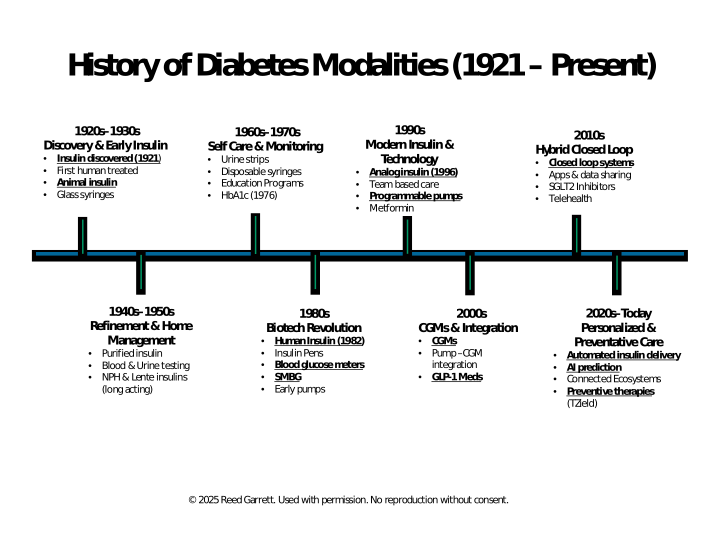
I walked students through the evolution of diabetes care – from the discovery of insulin in 1921 to modern closed-loop systems. Diagnosed in 1963, I’ve experienced most of these therapies, and I shared those that improved my quality of life:
- Human insulin (1982)
- Blood Glucose Self-Monitoring (1980s)
- Pumps and Pens (1990s)
- Insulin Analogs (1996)
- Continuous Glucose Monitors (2006)
- Automated Insulin Systems (2010s)
Seeing a timeline of modalities helped the nursing students understand how far treatment has come, but still well short of a biological cure. Afterward, one of the students said seeing this historical timeline really helped them appreciate the current modalities.
My Best & Worst Practices
I shared what I consider my best and worst practices of living with diabetes. I’ve listed them below, and you can read more about them here.
Top 5 Best Practices
- Nailing Basal Rates
- Fewer Carbs (not low carbs)
- Exercise … the great equalizer
- Dental Care
- Proactive Insulin Moves
Bonus Tip: Medical Device & Pharma Reps
Top 5 Worst Practices
- Living Alone (one nocturnal hypoglycemic reaction is one too many)
- Judging Blood Sugars
- Not Sharing My Diabetes
- Stacking Insulin
- Consuming alcohol on an empty stomach
The Mental Toll of Living with Diabetes
By now, the nurses had a good idea of what it’s like to live with diabetes.
But I emphasized this: there are no days off. And diabetes is expensive … VERY expensive. And while some days go smoothly, others are crud days… they suck. And there is a long list of fears that we face.
But diabetes doesn’t have to be a downer. Challenges can bring out the best in people.
And you know what? That’s where nurses enter the room.
How Nurses Help
Nurses have a blend of clinical knowledge, compassion, and time with patients. In my life with diabetes, nurses have made a difference by listening to my concerns and explaining the ever-changing treatment options. Here are a few examples:
Diabetes Tech
In 1983, during an appointment, a nurse took a blood sample from my finger and applied it to the end of a strip. She then wiped the blood off and inserted the strip into a handheld meter. She said the meter would measure my blood glucose. I thought it was cool that blood sugar could be tested in real time instead of sending it to a lab (which had been the case for 2 decades). Then she said, “The meter and strips are yours to take home.” I couldn’t believe it. My life with diabetes changed. I was empowered to test my blood sugar throughout the day … and make better choices about food, exercise, and sleep. My quality of life improved … thanks to a nurse.
In 1989, a nurse in Atlanta, Pat R, spent time over several days in a hospital showing me how to use my first insulin pump. She explained basal rates and bolus calculations (new terms to me) and how they would help my blood glucose control. She educated me on how to work the pump, including cartridge and infusion set changes, button presses, and menus. Her bedside manner put me at ease. I became confident with the pump … thanks to a nurse.
In 2006, two nurses opened my world to continuous glucose monitors. Deb B, a Certified Diabetes Educator in my endocrinology practice, found the nearest Dexcom clinical specialist, Carol V. Carol flew to Kansas City and shared the first-generation Dexcom with me. Both Deb and Carol were enthusiastic and supportive. And for the first time, I had real time trend blood glucose data. … thanks to nurses.
Exercise
I was asked by the KC JDRF chapter to ride 100 miles on a bicycle to raise money for diabetes research. They thought it would be inspiring to have a person with type 1 diabetes participate. Although I was in good physical shape, I hadn’t ridden a bike since college – and I was 47 at the time.
I sought the help of Nan B, a diabetes educator specializing in nutrition and exercise. Nan also lives with type 1 diabetes. She taught me the importance of understanding heart rate zones and proper nutrition during long-duration exercise. With her guidance, I trained and completed the 100-mile ride in Whitefish, Montana.
Since then, cycling has become a regular part of my health routine, and I now aim to ride 2,500 miles each year.
Nutrition
While living in Atlanta, I attended Diabetes University, a one-day conference hosted by the Diabetes Association of Atlanta. During the event, I attended a breakout session on nutrition led by Marti C, a Registered Dietitian, Certified Diabetes Educator, and Board-Certified Clinical Nutritionist. Although she lived in South Carolina, I followed up with her afterward.
We met regularly by phone, and she taught me the macronutrients in food: protein, carbohydrates, and fat. Together, we made dietary changes that emphasized adequate protein and the right types of fats. The result was smoother blood sugars after meals.
Scripts
In the United States, prescriptions are required to obtain insulin and diabetes supplies. Josie is a nurse in my endocrinology practice in Kansas City. She is responsive and goes the extra mile to ensure my prescriptions are accurate and filled on time.
These are a few examples of how nurses have helped smooth my journey living with diabetes. They led with knowledge and empathy, building trust in our relationship. They became part of my diabetes A-Team.
My Central Message to Nursing Students
If you take one thing away, let it be this: You will never know how much calm you can bring to a patient with your presence, tone, and empathy.
Technology changes. Insulins evolve. Pumps get smarter. But the human connection between nurse and patient? That’s timeless.
Closing Thoughts
Speaking to nursing students reminded me that diabetes care is a partnership. It’s technical, emotional, mathematical, and deeply human. Sharing that with future nurses was an honor.
If my story can help nursing students better understand the lives of patients living with diabetes, then it’s worth sharing far and wide.
