A 25-Year Perspective on Innovation, Market Leadership, and What’s Next for Patients
Three Observations
- Corporate fit matters more than scale.
- Innovation slows when companies optimize process over patient experience.
- In diabetes tech, trust and performance determine market leadership.
For those of us living with Type 1 diabetes, these shifts are not abstract. They shape the devices we wear, the alarms that wake us, and the margins of safety we rely on every day.
Medtronic Diabetes Spin-Off
After twenty-five years in diabetes, Medtronic is doing something once considered unthinkable: separating from the business that helped define modern insulin pump therapy.
Last week, Medtronic announced plans to divest its diabetes division through an initial public offering, with pricing expected on March 5, 2026. The full separation is expected to be completed later in 2026.
Medtronic’s diabetes business manufactures insulin pumps with proprietary algorithms, software, reservoirs, infusion sets, and accessories. It also offers insulin pens, injection ports, and continuous glucose monitors. These products are sold in more than 80 countries and are supported 24 hours a day.
Part one examines Medtronic’s first twenty-five years in the diabetes industry, my experience with its products, the dynamics of the diabetes medical device market, and my assessment of its performance. A second part will examine the strengths that a divested and new MiniMed can leverage, as well as the keys to returning to market leadership
Let’s start with the reasons why Medtronic is divesting its diabetes business.
The Reasons: Fit. Focus. Fiscal. Leadership.
Why, after twenty-five years, is Medtronic divesting its Diabetes business? There are four reasons:
Fit.
Decisions for diabetes products are made by patients with the help of medical professionals. This requires marketing strategies that align with consumer needs, including marketing, education, technical support, customer retention, product upgrades, and social media. The three other Medtronic business units (Cardiovascular, Surgical, and Neuroscience) sell directly to medical professionals and institutions and involve relationship selling based on clinical evidence and surgeon preference. Medtronic is known for bundling products for institutional buyers, and diabetes products are not part of that product mix. Simply put, the diabetes unit lacks synergy with Medtronic’s other businesses.
Focus.
The rapid innovation in the diabetes medical device industry requires attention to the needs of patients, families, and medical professionals. It also requires attention to product management and investment decisions. Product cycles – three to five years for devices and months for software – will benefit from a tighter focus. While one can argue that Medtronic’s diabetes management team has been focused, the new company will have a Board of Directors dedicated to its business model, patient satisfaction, and shareholder returns. That’s long overdue.
Fiscal.
Medtronic’s diabetes unit lags in its contribution to the company’s financial performance. Diabetes makes up less than 10% of Medtronic’s sales. Although Medtronic doesn’t disclose operating profits by division, analysts believe the diabetes division is a drag on the company’s 24.1% operating margin. If true, divesting the diabetes business will be accretive for Medtronic.
Leadership.
Since purchasing MiniMed in 2001, Medtronic’s Diabetes Division has moved from a market-leading position to a market laggard in insulin pumps. But Medtronic’s largest misstep was in continuous glucose monitoring. The purchase of MiniMed included a first-generation CGM solution, but it was surpassed by the start-up CGM company Dexcom. Abbott also joined the CGM market. Today, the CGM Market is estimated at $10-13 billion in sales. Analysts’ reports estimate Medtronic’s share at roughly 7%. That is a stunning reversal for a former market leader.
Winston Churchill once said, “The farther backward you can look, the farther forward you are likely to see.” To understand the decision to divest, let’s revisit how Medtronic entered the diabetes market in the first place.
Early Days
After the turn of the millennium, Medtronic sought a new growth market as demand for its mature business units slowed. Medtronic did not have a product presence in diabetes, and it believed the diabetes market would grow (and it was right!). It purchased MiniMed Technologies, the dominant U.S. insulin pump company, in May 2001. Then, these were the modalities for diabetes treatment:
- Medications (Insulin, Oral)
- Infusion Technology (Syringes, Pumps, Pens)
- Glucose Monitoring (Labs, Meters)
- Lifestyle (Diet, Exercise, Mind)
- Data (Logs, Meters, Pumps)
Medtronic correctly recognized that insulin delivery – not pharmaceuticals – aligned with its core engineering competencies in medical devices.
My first pump was a MiniMed 504-S that I purchased in 1989. For its time, the 504-S was innovative and a difference maker.
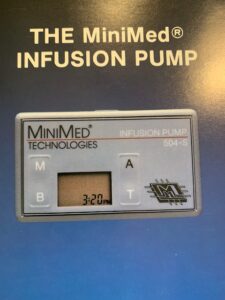
MiniMed 504-S Pump (1989)
It allowed different basal patterns and bolus ratios throughout the day. I used buffered Regular insulin, and my nocturnal blood sugar levels stabilized. That was a life changer compared to the inconsistent and sometimes life-threatening action of long-acting insulins like NPH. Importantly, the pump was reliable. I trusted it.
MiniMed’s strategy for selling its diabetes products was to medical professionals. When I asked my endocrinologist which pumps were available (I had done research), he said there was only one pump he used, MiniMed. He said the decision was his, not mine. (That was the first and last time I was left out of the decision-making process.)
Medtronic’s financial wherewithal enabled expansion of the field staff and the pump’s reach outside the United States. It also reengineered the 508 pump it inherited and named it the Paradigm. It provided a more readable screen, improved battery performance, a proprietary reservoir lock, two sizes (the 500 and 700 series), an RF-based wireless link for communicating with blood meters, and, eventually, integration with continuous glucose technology.
Medtronic was fiercely (and rightfully) protective of the patents it acquired from MiniMed. Meanwhile, competitors like Cozmo (by Deltec, Smiths Medical diabetes division) innovated with a contemporary design and features, including a touch bolus button. Children loved the Cozmo for its modern design and innovative features, and, along with Animas, it began to gain market share. Medtronic responded by suing Smiths Medical in 2003 for infringing its intellectual property. The two companies settled out of court, and Smiths Medical subsequently ceased selling the Cozmo pump. Diabetes patients and families were frustrated with the loss of the Cozmo pump and fewer choices in the insulin pump market.
Diabetes Market Dynamics & Transformation
The 2000s were transformative for the diabetes device market. After Medtronic bought MiniMed in 2001, Roche acquired Disetronic, the second-largest pump company, in 2003. Johnson & Johnson followed suit when it bought Animas in 2005. Although the pumps improved, they largely retained the same form factor (body).
New players changed that.
Starting in 2005, Insulet rolled out a tubeless ‘Pod’ looking pump that attached directly to the skin. Patients wanting pump therapy embraced the Omnipod. Patients loved not having to ‘tuck in’ tubing on this new ‘patch pump.’ Financially, ‘The Pod’ did not require a significant upfront cash outlay. Rather, each Pod was billed when ordered. Patient’s budgets valued that.
In 2007, a popular diabetes blogger, Amy Tenderich, wrote a blog post titled “An Open Letter to Steve Jobs.” In it, she called on Apple to apply its cool, innovative, consumer-appealing designs to medical devices currently designed by engineers and physicians. She wanted insulin pumps to “look good and feel good.”
One company listened.
Tandem Diabetes was founded in 2008 and conducted interviews with over 4,000 insulin pump users. Their feedback influenced the design of Tandem’s first pump, the t:slim, which was approved for sale in the US in 2012. The pump’s design was compact and navigated via color touchscreen menus. It looked cool. It was reliable and provided good blood glucose control. It became the choice for many patients wanting pump therapy, including our son, who was diagnosed in 2013.
But Tandem ran into a buzzsaw when Medtronic released the 670g pump in 2017. It was the first FDA-approved hybrid closed-loop pump (an unapproved ‘we are not waiting’ Loop algorithm was available in 2015). JDRF (now renamed Breakthrough T1D) announced it as an Artificial Pancreas – a name Medtronic never used – and the media provided ample coverage.
And patients couldn’t wait to get their hands on it.
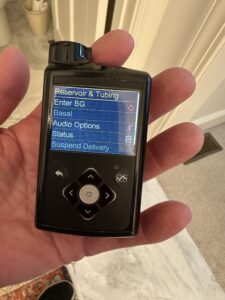
Medtronic 670G (2017)
As the warranty on my Medtronic Paradigm pump expired, I had a decision: go with a proven, cool design with an intuitive touch screen menu with no HCL algorithm or a first generation larger bodied pump with an algorithm that promised improved blood sugar control and less patient decision making (meals were still announced and bolused by the patient).
I chose function over form.
(Full disclosure: I tried a Tandem pump for a week and loved the way it looked and worked, but couldn’t resist the promise of Medtronic’s algorithms. When I told the local Tandem Sales rep my decision, she said, “I understand. Right now, it’s really hard to sell pumps if you’re not Medtronic.”)
But Medtronic’s closed ecosystem included a CGM setup that was difficult to insert and less reliable than Dexcom’s. The algorithm guiding the Medtronic HCL system did not work well for me. Despite adjusting my sensitivity and carb ratios for months with my endocrinologist and Medtronic clinical specialist, my post-prandial (after-meal) blood sugars skyrocketed rapidly beyond 300 (and I don’t do 300!). Furthermore, the algorithm would not lower my elevated glucose levels before my next meal. I was surprised as my postprandial glucose levels were not elevated when I used the Loop software. Eventually, I returned the 670g to the box it arrived in.
So did others.
This was a lifesaver for Tandem, which, in 2017, was months away from default due to the promise of Medtronic’s HCL and a decision by UnitedHealthcare to make Medtronic the insurer’s exclusive in-network supplier of insulin pumps.
Because of issues with Medtronic’s first-generation hybrid closed-loop pump, patients returned to Tandem’s cool and patient-friendly design. And Tandem continued to innovate by adding a similar hybrid closed-loop algorithm, Control IQ, in 2020. Software updates were done over the internet (Medtronic’s updates required a replacement pump). Patients preferred Tandem because of its innovative design, menu navigation, algorithm, and, importantly, a reliable and user-friendly CGM from Dexcom.
By the mid-2020s, Medtronic was no longer setting the pace of innovation. It was reacting to it. After twenty-five years in diabetes, its results are mixed.
Assessment
Medtronic’s first quarter-century in the diabetes device market included strengths and shortcomings. Here is my assessment of what worked and what could have been done better.
The Good
Paradigm Pumps.
Following its acquisition of MiniMed, Medtronic reengineered and improved the 500 series pump. The result was a continued reputation for quality and trust by medical professionals and patients. This was my go-to infusion device for over a decade. They were reliable, and each iteration improved. I trusted Medtronic’s reengineered pumps.

Medtronic Paradigm 522 (2006)
Expanded Reach.
Medtronic expanded into new geographic markets, selling its diabetes devices in more than 80 countries and offering a gold standard in insulin therapy. More patients benefited.
Customer Service.
Medtronic’s customer service remained outstanding. Field staff educated physicians’ offices and conducted patient training classes. If a pump malfunctioned, a replacement pump was almost always sent overnight. If I had a question, answers were immediate – and helpful. Medtronic supported their pumps and patients.
First To Market with HCL.
Medtronic was the first to market an FDA-approved hybrid closed-loop pump (and first-generation products generally have bugs). As disappointed as I was with its performance, I give Medtronic high marks for developing an algorithm designed to reduce the decision-making burden on patients, their families, and loved ones. Furthermore, Medtronic invested time, talent, and money in working with the FDA to obtain approval for the system.
Multiple Modes.
A feature I particularly value with Medtronic closed-loop pumps is the ability to toggle between suspend before low and hybrid closed-loop modes. Tandem, Omnipod, and Loop algorithms don’t have that option.
The Bad
Playing Defense.
Medtronic paid $3.7 Billion to acquire MiniMed. It rightfully protected the intellectual capital included in the purchase. Medtronic sued Smiths Medical, and quickly, Cozmo, a pump loved by many patients, was no longer available. But why didn’t Medtronic spend time and energy innovating its pumps to delight patients? Diabetes patients lost out. So did Medtronic.
600 & 700 Series Pump Design.
In the late 2000s, the industry was ripe with rumors about a newly designed pump from Medtronic. It was long overdue. The green screen was outdated and was too small for the expanding insulin delivery and CGM functions. When the 600 series pumps were introduced in 2016, a color screen was welcome, but I was surprised by the number of menus. They weren’t navigated by touch screen, but by small buttons around a circle. The Easy Bolus button, which I primarily use, was as difficult to use as it was easy on the 500 series pumps.
Process vs Patient.
I am trained in Six Sigma. While the framework is important, the target is paramount. Improvement is limited when applying Six Sigma to a process. The big gains (and innovation) come when applied to the customer. I remember Bell Labs trainers emphasizing, “Start with the Voice of the Customer (VOC), not the Voice of the Process (VOP). The VOP should be designed to deliver the VOC!” While large companies Medtronic, J&J, and Roche worked within the lanes they acquired, they were ultimately surpassed by new entrants that prioritized patient input (rather than engineers and physicians).
The Ugly
Device Quality and Regulatory Issues.
Medtronic’s pumps and CGMs experienced breakdowns, including battery failures, pump shutdowns, and software glitches. In the US, the FDA issued recalls requiring corrections to manufacturing, device upgrades, and communications to patients and medical professionals (my inbox is full of these). CGM devices were inaccurate and suffered from transmitter connectivity and signal quality. The cost of quality (or lack of it) adds expense, and Medtronic had to invest in quality checks, software validation, and time with the FDA. Regulatory oversight slowed time-to-market for new products.
Closed architecture.
As software algorithms connected pumps and CGMs, Medtronic chose a closed ecosystem. It made sense. By using internally developed products, Medtronic could control all variables and be the first to market. And economics would have been optimal by generating recurring revenues from CGM sensors/transmitters and pump infusion sets/cartridges. However, due to the quality issues noted above, the closed ecosystem led to a loss of market leadership for both CGMs and pumps. In 2025, Medtronic began opening its ecosystem to work with Abbott’s CGM products.
CGM Miss.
Medtronic’s purchase of MiniMed included the first FDA-approved continuous glucose monitor (CGM). Introduced in 1999, it was a blinded device with data available only to physicians. In April 2005, Medtronic received FDA approval for the first real-time patient device, the Guardian Real Time. Dexcom, a CGM start-up company, received FDA approval for its first-generation CGM, the STS, in March 2006. Medtronic’s design and performance were especially disappointing. Continuous Glucose Monitoring became a large market ($10-13 billion in 2025) that Medtronic could have led. The CGM market is dominated by Dexcom, Abbott, and Medtronic. Today, Medtronic’s share is estimated at roughly 7% (based on analysts’ reports).
What This Means
For investors, the new MiniMed is about focus, margins, and valuation.
For diabetes patients and medical professionals, it marks the end of an era … and the beginning of another.
The question is no longer why Medtronic is spinning off its diabetes business.
It is why it took this long.
In Part Two, I will examine whether the new MiniMed has the ingredients required to return to market leadership.

About the Author
Reed Garrett lives with Type 1 diabetes and is a voice for living well with Type 1. His work includes writing about innovation, decision-making, and trust in diabetes technology. He is the creator of ReedOnDiabetes.com and speaks on the intersection of lived experience and medtech strategy.